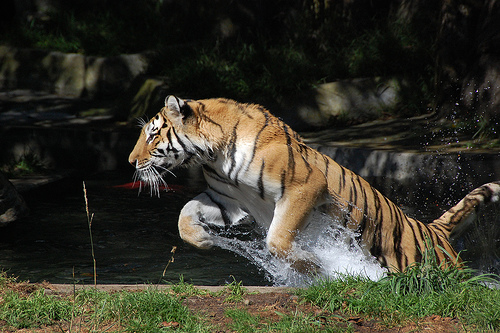
Showing posts with label Tiger. Show all posts

Tuesday, April 5, 2011

White Tiger


True Wild Life | White Tiger | The white tigers originated in the pure Bengal strain in India. Later in captivity Siberian was crossed in to make a bigger more impressive white tiger. They do have some pigment, so they are not albinos. The white tiger has a shorter life expectancy than the orange tiger, thought to be due to the white tigers mutated genes and to the inbreeding depression necessary to perpetuate the bloodline. The white tiger was always rare to come across in the wild in India, and none have been seen in the wild for over 50 years. The gene that causes the background to be white is a simple recessive. For that reason to produce whites they must be mated either to other whites or to normal orange tigers that are carriers of the white gene. The white tiger has been known to give birth to an orange tiger when mated to an orange male. Cubs of both colors occur in the same litter.


White tigers have also sadly appealed to those who are rich who either display the white tiger in captivity or killed the white tigers for their fur. For that reason white tigers are no longer seen in the wild. All were captured for captive breeding programs or killed as trophies for rich hunters. It has been speculated that some white tiger individuals are born with a blue tinge to their black stripes. Although this has not been recorded, it is possible for a genetic mutation to occur diluting the black stripes of the white tiger a blue/gray color. This dilution of black to blue is common in horses, cats, and dogs.


As white tigers are simply a different coloured version of the normal orange tiger, there are very few differences (if any at all) in the white tiger's behaviour. The white tiger lived in a jungle habitat where there was plenty of cover for the white tiger to remain hidden and to keep on the look out for potential prey. However, they did tend to stand out against their backgrounds and did not camofluage as effectively as normal orange tigers


The tiger is a carnivorous mammal and a fearless predator hunting large mammals including deer, wild boar and cattle. Tigers are extremely stealthy animals and are able to sneak up on their prey and catch it off guard. This makes the tiger a ruthless and dominant predator within its environment. The tiger is a solitary animal and it requires a large territory in order to ensure that there is an adequate food supply. Tiger cubs remain with their mother until they are strong enough and experienced enough to hunt for themselves.

Saturday, March 26, 2011

Tiger


True Wild Life | Tiger | The tiger is the largest feline in the world, with the tiger growing to around 2.5 metres in length. The tiger is the most powerful of all the big cats, and is native to east and southern Asia. The tiger is feared by most human beings who inhabit settlements within the tiger's territory. There are six different subspecies of tiger which are the Bengal tiger, the Indochinese tiger, the Malayan tiger, the Sumatran tiger, the Siberian tiger and the South China Tiger. The white tiger is actually a Bengal tiger and is therefore not a subspecies itself.


The average tiger weighs around 300kg and a tiger can stretch its body (and tail) to roughly 4 metres. Tigers hunt snakes, boar, buffalo, crocodiles, deer, leopards and camels and are extremely effective at catching their prey due to their silent, stalking approach and their powerful bodies. The tiger can reach speeds of up to 90km an hour, making the tiger extremely fast. Tigers have even been known to conflict with rhinos and elephants with the tiger generally winning.


Tigers are generally orange with black stripes although it's common to get tigers with white and sandy coloured markings. The white tiger is a rare type of tiger, with bright white fur and black stripes, these tigers occur from a genetic mutation when in the mother tiger's womb. It is not certain that these white tigers will produce white offspring, many white tigers have been known to produce orange cubs. Today the tiger is a near endangered species with only a handful still roaming the Asian jungles. The tiger is still a completely dominant predator in it's environment particularly due to their extreme power, and ability to run, swim, jump and climb trees very effectively.


The tiger is a highly adaptable animal with the tiger's territory ranging from Siberia, to open grasslands and tropical mangrove swamps in central and south-east Asia. The tiger is also an extremely territorial animal and the tiger is generally a solitary animal. Due to the tiger's size and the tiger's want to be solitary, the tiger often requires large areas of habitat that can support the tiger's prey demands. Because of the tiger's need for a large territory mixed with the fact that the tiger is native to some of the more densely populated places on earth, has meant that there have been significant conflicts between tigers and humans.


Tigers usually mate from November to April and after a gestation period of just over 3 months, the female tiger gives birth to 2 or 3 tiger cubs. When the tiger cubs are first born they are blind and extremely vulnerable. By the time the tiger cubs is around 18 months old, it is able to hunt for itself. Tiger cubs are known to grow rapidly and can put on 100 g of weight every day. The tiger cubs usually stay with their mother until they are between 2 and 3 years old and the tiger cubs are then big enough and strong enough to venture out into the jungle to live a life of solitude.

Wednesday, March 23, 2011

Sumatran Tiger


True Wild Life | Sumatran Tiger | The Sumatran tiger is the smallest subspecies of tiger in the world, with male Sumatran tigers rarely growing to 2.5 meters in length. The Sumatran tiger is today a critically endangered species of tiger with only around 500 thought to be in the wild. The Sumatran tiger is natively found only on the Indonesian island of Sumatra where the Sumatran tiger can be found inhabiting a variety of habitats from low and highland areas, to mountainous jungle and peat swamp forests.


The is Sumatran tiger the smallest species of tiger meaning that the Sumatran tiger is able to move through dense jungle with greater ease than it's larger cousins. The Sumatran tiger is quite different in appearance to other tiger species as the stripes of the Sumatran tiger are narrower than those of other tiger species and they also have larger manes. Sumatran tigers have slightly webbed paws which allows them to swim more efficiently after their prey.


The Sumatran tiger is a dominant and carnivorous predator, hunting it's prey by stalking it until the Sumatran tiger has the opportunity to catch it off guard. Sumatran tigers primarily hunt larger mammals including deer, wild boar, cattle and goats. Due to the size and power of the Sumatran tiger, it has no natural predators in its native environment. Humans that hunt the Sumatran tiger and habitat loss are the only threats to the Sumatran tiger.


After a gestation period of 3 to 4 months, the female Sumatran tiger gives birth to up to 5 cubs. Newborn Sumatran tiger cubs weigh about 1 kg (2 lb) and are blind and helpless. The mother feeds them milk for about 2 months and then the Sumatran tiger cubs are introduced to meat. Sumatran tiger cubs depend on their mother for the first 18 months and then they start hunting on their own. Today, due to habitat loss caused by deforestation, and hunting by human poachers, the Sumatran tiger is considered to be a critically endangered species. Modern estimates suggest that the current wild Sumatran tiger population is as low as 400 to 500 individuals.

Tuesday, March 22, 2011

South China Tiger


True Wild Life | South China Tiger | The South China tiger (also known as the Amoy, Chinese or Xiamen tiger) is a smaller-sized subspecies of tiger native to the forests of southern China. The South China tiger is the most critically endangered tiger species with only a handful left in the wild. The South China tiger is natively found in the temperate upland forests of southern China, where its once wide range has now been reduced to a few isolated populations, which are said to be found inhabiting the mountainous borders between provinces.


The South China tiger is one of the smallest species of tiger behind the Sumatran tiger and the Malayan tiger. As with the other smaller sized tiger species, the small size of the South China tiger allows it to move through the dense jungle more easily. Like other tiger species, the South China tiger is known to be a strong and capable swimmer, often able to catch its prey when its in the water. This hunting strategy only works however if the South China tiger is faster than the animal it is hunting.


The South China tiger is a dominant and carnivorous predator, hunting it's prey by stalking it until the South China tiger has the opportunity to catch it off guard. South China tigers primarily hunt larger mammals including deer, wild boar, cattle and goats. Due to the size and power of the South China tiger, it has no natural predators in its native environment. Humans that hunt the South China tiger and habitat loss are the only threats to the South China tiger.


After a gestation period of 3 to 4 months, the female South China tiger gives birth to up to 5 cubs. Newborn South China tiger cubs weigh about 1 kg (2 lb) and are blind and helpless. The mother feeds them milk for about 2 months and then the South China tiger cubs are introduced to meat. South China tiger cubs depend on their mother for the first 18 months and then they start hunting on their own.


Today, due to habitat loss caused by deforestation, and hunting by human poachers, the South China tiger is considered to be a critically endangered species. The South China tiger is the most critically endangered species of tiger and one of the 10 most endangered animals in the world, as there are thought to be less than 20 South China tigers left in the wild.

Monday, March 21, 2011

Siberian Tiger


True Wild Life | Siberian Tiger | The Siberian tiger (also known as the Amur and the Ussuri tiger) is a large subspecies of tiger, found throughout western and central Asia. The Siberian tiger is the largest species of tiger in the world closely followed by the Bengal tiger, found on the Indian subcontinent. The Siberian tiger was once found across central and western Asia and throughout Russia, but conflict and deforestation has made the Siberian tiger extinct in much of its native habitat. Today the Siberian tiger's range is restricted to parts of eastern Siberia where it is now a protected species.


The Siberian tiger is considered to be the largest subspecies of tiger, although recent reports suggest that the Bengal tiger is on average, larger than the Siberian tiger. The Siberian tiger has thick fur to keep it warm during the bitter Siberian winter, that can grow to 4 inches long on its neck and tummy. In parts of Siberia where the range of the Siberian tiger's habitat overlaps that of other large predators such as bears and wolves, the Siberian tiger is known to be a more dominant predator either chasing off or killing its competitors.


The Siberian tiger is a dominant and carnivorous predator, hunting its prey by stalking it until the Siberian tiger has the opportunity to catch it off guard. Siberian tigers primarily hunt larger mammals including deer, wild boar, cattle and goats. Due to the size and power of the Siberian tiger, it has no natural predators in its native environment. Humans that hunt the Siberian tiger and habitat loss are the only threats to the Siberian tiger.


After a gestation period of 3 to 4 months, the female Siberian tiger gives birth to up to 5 cubs. Newborn Siberian tiger cubs weigh about 1 kg (2 lb) and are blind and helpless. The mother feeds them milk for about 2 months and then the Siberian tiger cubs are introduced to meat. Siberian tiger cubs depend on their mother for the first 18 months and then they start hunting on their own. Today, due to habitat loss caused by deforestation, and hunting by human poachers, the Siberian tiger is considered to be an endangered species. Despite being the largest of all the tiger species, there are thought to be less than 500 Siberian tigers left in the wild.

Friday, March 4, 2011

Malayan Tiger


True Wild Life | Malayan Tiger | The Malayan tiger is a smaller-sized subspecies of tiger, found throughout Malaysia and parts of Thailand. The Malayan tiger is today an endangered species but one of the more numerous wild tiger species. The Malayan tiger is found throughout the southern and central parts of the Malay Peninsula with its range also extending into parts of southern Thailand. The Malayan tiger is found inhabiting the less-dense forests and jungles where there is a higher supply of food.


The Malayan tiger is the smallest species of tiger along with the Sumatran tiger, with average female Malayan tigers growing to around 2 meters in length. The smaller size of the Malayan tiger helps it to remain unseen in the clearer parts of the Malaysian jungle. The Malayan tiger was once thought to be the same as the Indochinese tiger, a larger tiger species found in the more northern parts of south-east Asia, and it was only recently that the two were classified as separate subspecies.


The Malayan tiger is a dominant and carnivorous predator, hunting it's prey by stalking it until the Malayan tiger has the opportunity to catch it off guard. Malayan tigers primarily hunt larger mammals including deer, wild boar, cattle and goats. Due to the size and power of the Malayan tiger, it has no natural predators in its native environment. Humans that hunt the Malayan tiger and habitat loss are the only threats to the Malayan tiger.


After a gestation period of 3 to 4 months, the female Malayan tiger gives birth to up to 5 cubs. Newborn Malayan tiger cubs weigh about 1 kg (2 lb) and are blind and helpless. The mother feeds them milk for about 2 months and then the Malayan tiger cubs are introduced to meat. Malayan tiger cubs depend on their mother for the first 18 months and then they start hunting on their own. Today, due to habitat loss caused by deforestation, and hunting by human poachers, the Malayan tiger is considered to be an endangered species. Modern estimates suggest that the current wild Malayan tiger population is between 600 and 800 individuals, making it one of the more numerous tiger species.

Wednesday, March 2, 2011

Indochinese Tiger


True Wild Life | Indochinese Tiger | The Indochinese tiger (also known as the Corbett's tiger) is a subspecies of tiger, found throughout south-east Asia. The Indochinese tiger is now an endangered species and actually thought to be extinct in the Chinese wild today. The Indochinese tiger is found throughout Cambodia, Laos, Thailand, Burma and Vietnam, although the Indochinese tiger's range is much smaller now than it once was and no Indochinese tigers have been seen in the wild in China since 2007.


The Indochinese tiger is a medium sized species of tiger that is found inhabiting the secluded forests in the mountainous regions that generally lie along the borders between countries. This makes studying the Indochinese tiger very difficult so not much is known about them. The Malayan tigers found in Malaysia and parts of Thailand, were once thought to be the same as the Indochinese tiger and it was only recently that the two were classified as separate subspecies.


The Indochinese tiger is a dominant and carnivorous predator, hunting it's prey by stalking it until the Indochinese tiger has the opportunity to catch it off guard. Indochinese tigers primarily hunt larger mammals including deer, wild boar, cattle and goats. Due to the size and power of the Indochinese tiger, it has no natural predators in its native environment. Humans that hunt the Indochinese tiger and habitat loss are the only threats to the Indochinese tiger.


After a gestation period of 3 to 4 months, the female Indochinese tiger gives birth to up to 5 cubs. Newborn Indochinese tiger cubs weigh about 1 kg (2 lb) and are blind and helpless. The mother feeds them milk for about 2 months and then the Indochinese tiger cubs are introduced to meat. Indochinese tiger cubs depend on their mother for the first 18 months and then they start hunting on their own. Today, due to habitat loss caused by deforestation, and hunting by human poachers, the Indochinese tiger is considered to be an endangered species. Modern estimates suggest that the current wild Indochinese tiger population is between 1,200 and 1,800 individuals.

Thursday, October 28, 2010

Smilodon ( Sabre-toothed Tiger)


True Wild Life | Smilodon | The Saber Tooth Tigers are some of the best known and most popular of ice age animals. They are among the most impressive carnivores that ever have lived. Two different types of saber toothed tigers lived in the mid-western U.S. at the end of the ice age. One of the most familiar saber tooth tiger was (genus smilodon). These cats had enlarged canines usually associated with the name saber tooth. Their canines were up to 7 inches long (18 centimeters)! The second type is the less known (genus Homotherium). These cats had shorter canines about ten centimeters (4 inches) long. The canines were also flatter at the tips. Some of the differences can be seen by comparing the homotherium cat to the smilodon cat.


The sabre-toothed tiger is one of the most well-known prehistoric animals along with giants such as the woolly mammoth. Sabre-toothed tigers roamed the mid-western US and parts of both North and South America and were named for the enormous canines which skeletons show, protruded quite far out of their mouths. Despite it's name, the sabre-toothed tiger was not actually related to the modern tigers that are found throughout the jungles of Asia. It is thought that the sabre-toothed tiger would have roamed across the grassland plains and open woodlands throughout both North and South America where individuals would of varied slightly depending on the area which they inhabited.

The sabre-toothed tiger is one of the best known ice-age animals but little is really known about them as they are thought to have become extinct around 10,000BC which is a long time ago. The sabre-toothed tiger was named for the canines that could grow to more than 7 inches in length and were capable of fatally wounding their prey with one bite. Sadly, the colour of the sabre-tooth tiger is unknown but it is thought that is would of been of a similar colouration to the modern day lion found in Africa (and which it is not closely related to). The sabre-toothed tiger also had a powerful, muscular body which meant that it could quickly catch and pounce on it's prey before using it's knife-like teeth to cause to the fatal blow.


In the same way as modern day felines, the sabre-toothed tiger was a carnivorous animal and would of been the most dominant predator within its environment. Large herbivorous animals such as deer and bison would of been the most common prey of the sabre-toothed tiger along with occasional giant such as a small woolly mammoth should their ranges cross, although their exact diet is unknown. The sabre-toothed cat would of been the most ferocious and therefore the apex predator within it's environment so had no natural predators on the American plains. Humans are thought to be the most likely cause for the demise of this enormous cat and more than 2,000 sabre-toothed tiger skeletons have been found emerged in the tar pits close to Los Angeles.


As with modern felines, the sabre-toothed tiger would of bred in the warmer months of early spring, when after a gestation period that could last as long as 8 months, the female sabre-toothed tiger would give birth to an average of 3 cubs per litter. Nothing is known about sabre-toothed tiger cubs but they could be born blind like the cubs of today's felines. The sabre-toothed tiger is thought to have become extinct more than 12,000 years ago when human settlers first arrived in the Americas, hunting this species to extinction. Although climate change could also be the primary cause for their demise, little however is really known.

Tuesday, October 26, 2010

Bengal Tiger


True Wild Life | Bengal Tiger | The Bengal tiger is the national animal of Bangladesh and is considered to be the second largest tiger in the world. The Bengal tiger (also known as the Royal Bengal tiger) is a subspecies of tiger, found across the Indian subcontinent. The Bengal tiger is the most numerous species of tiger in Asia and is found in dense forests and mangrove swamps and jungles throughout India, Bangladesh, Bhutan and Nepal, although the Bengal tiger's range today is much smaller than it once was.


The Bengal tiger is considered to be the second largest species of tiger, although recent reports suggest that the Bengal tiger is on average, larger than the Siberian tiger. The Bengal tiger has a yellow or light orange coat, with black or dark brown stripes and a white belly. The white tiger is a Bengal tiger that has mutated genes, meaning that it is white in colour with black stripes. Black tigers are known to have black fur with lighter coloured stripes but are even rarer than the white tiger.


The Bengal tiger is a dominant and carnivorous predator, hunting its prey by stalking it until the Bengal tiger has the opportunity to catch it off guard. Bengal tigers primarily hunt larger mammals including deer, wild boar, cattle and goats. Due to the size and power of the Bengal tiger, it has no natural predators in its native environment. Humans that hunt the Bengal tiger and habitat loss are the only threats to the Bengal tiger.


After a gestation period of 3 to 4 months, the female Bengal tiger gives birth to up to 5 cubs. Newborn Bengal tiger cubs weigh about 1 kg (2 lb) and are blind and helpless. The mother feeds them milk for about 2 months and then the Bengal tiger cubs are introduced to meat. Bengal tiger cubs depend on their mother for the first 18 months and then they start hunting on their own.


Today, due to habitat loss caused by deforestation, and hunting by human poachers, the Bengal tiger is considered to be an endangered species. Despite being the most common of all the tiger species, there are thought to be around 2,000 Bengal tigers left in the wild.

Liger


True Wild Life | Liger |  The liger is a big cat born from the breeding of a male lion and a female tiger. This combination produces an offspring with more lionistic features than if the reverse pairing had occurred. That would produce a more tigeristic creature known as a tigon. Both are members of genus Panthera.There is no scientific name assigned to this animal because it is a combination of two species. Some ligers grow impressive manes, while others do not. Ligers are prone to giantism and grow much larger than either parent. A liger looks like a giant lion with muted stripes but like their tiger ancestors, ligers like swimming.


Swimming goes against the nature of a lion but is what makes hybrid creature special. It gets the best of both parents. That is not always the case though with crossbreeds. Sometimes the results go the other way and the animal gets the worst of both parents. A tigon or tigron is a hybrid cross between a male tiger and a female lion or lioness. The tigon is not currently as common as the liger, however, in the late 19th and early 20th centuries, tigons were more common than ligers. Tigons tend to be the same size or smaller than their parents and have less angular heads. They have a stronger striping pattern generally.


As the liger is the offspring of two different animal species, the lion and the tiger, the liger is thought to be sterile in the same way as a mule or zonkey. However, the male ligers and tigons are sterile while the female ligers and tigons are generally fertile. The males typically have low testosterone and not very motile sperm. Because only female ligers and tigons are fertile, ligers and tigons cannot reproduce with each other. They can breed to a male of either parent species (tiger or lion) producing 3/4 tigers and 3/4 lions (ti tigon, ti liger, etc).