Wednesday, August 10, 2011

Huon Tree Kangaroo


True Wild Life | Huon Tree Kangaroo | Huon Tree Kangaroo (Dendrolagus matschiei), also known as the Matschie's Tree Kangaroo is a tree kangaroo  native to the Huon Peninsula of North Eastern New Guinea. Under the IUCN classification, Huon Tree Kangaroo is endangered. With a body and head length of 20 to 32 inches, Huon Tree Kangaroo are much smaller than Australia's well-known red kangaroo. 
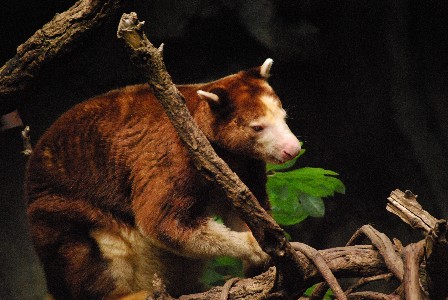

There is no particular season in which they breed. Gestation lasts 32 days and joeys of captive bred individuals leave the pouch after 13 ½ months. The average life span of the Huon Tree Kangaroo in the wild is unknown, but is at least 14 years. The life span of the kangaroo in a zoo is about 20 years. The Huon Tree Kangaroo can only be found on the Huon Peninsula on the northeast coast of Papua New Guinea. They live in forests that are usually foggy.Unlike other species of kangaroos, the Huon Tree Kangaroo spends most of its time living in trees. They even eat and sleep in trees.


The most distinctive trait of all tree kangaroos is the hair whorl they possess. It is a patch of hair that goes out in many directions and its location ranges from up near the shoulders all the way down to the tail. The Huon Tree Kangaroo is golden on its ventral side, lower parts of its limbs, ear edges, belly, and tail, and the rest of its body is a chestnut brown color, except for usually having a dark stripe down its back. Their faces are typically an array of yellow and white colors. The Huon Tree Kangaroos are similar in color and size to Dendrolagus dorianus, the Doria’s tree kangaroo. Huon Tree Kangaroos ears are small and bear-like looking and they do not have a good sense of hearing because of it. They have curved claws on their forelimbs and soft pads on their hind limbs that aid in their climbing ability, and they have some independent movement of their digits as well as good dexterity due to their forelimbs being able to bend a great deal.


The Huon Tree Kangaroo are mainly folivorous, eating anything from leaves, sap, insects, flowers, and nuts.  Since they eat high fiber foods, they only eat maybe about 1 to 2 hours throughout the day and the other time of the day they are resting and digesting their food. Their digestion is similar to that of the ruminants; they have a large, “tubiform forestomach”, where most of the fermentation and breakdown of tough material takes place at; in the hind stomach, there is a mucosa lining with many glands that help absorption begin here.


The Huon Tree Kangaroo lives only on the Huon Peninsula of Papua New Guinea. Usually we think of kangaroos as animals that hop around grasslands. However, Huon Tree Kangaroos are an exception. They live in forests and are more adept at climbing trees than they are at moving on land. Today, as the population on the Huon Peninsula grows, more and more of the kangaroo's precious forests are being converted into farmland. Continued habitat loss is pushing the Huon Tree Kangaroo toward the brink of extinction.

Goodfellow's Tree Kangaroo

 
True Wild Life | Goodfellow's Tree Kangaroo | Goodfellow's Tree-kangaroo also called the Ornate Tree Kangaroo, belongs to the family Macropodidae, which includes kangaroos, wallabies and their relatives. The species is native to the rainforests  of New Guinea, and the border of central Irian Jaya in Indonesia.  Under the IUCN classification, the species is listed as Endangered, which is a result of overhunting and human encroachment on their habitat.


Like other tree-kangaroos, Goodfellow's Tree-kangaroo is quite different in appearance from terrestrial kangaroos. Unlike its land dwelling cousins, its legs are not disproportionately large compared to its forelimbs which are strong and end in hooked claws for grasping tree limbs, and it has a long tail for balance. All of these features help it with a predominantly arboreal existence. Goodfellow's Tree-kangaroo has short, woolly fur, usually chestnut to red-brown in color, a gray-brown face, yellow-colored cheeks and feet; a pale belly, a long, golden brown tail, and two golden stripes on its backside.  It weighs approximately 7 kg. 


Although it feeds mainly on the leaves of the Silkwood tree, other morsels are accepted when available, including various fruits, cereals, flowers and grasses.  It has a large stomach that functions as a fermentation vat, similar to the stomachs of cows and other ruminant  herbivores, where bacteria break down fibrous leaves and grasses.


Unlike other kangaroos, Goodfellow's Tree Kangaroos like to stay in the treetops rather than hopping around on the ground. They choose to live in the treetops to protect themselves from enemies on the ground. The New Guinea Island used to be rich in nature but as it became the major exporter of lumbers and minerals, the forests were destroyed by the human. The more and more safe places to live for Goodfellow's Tree Kangaroos are now disappearing.


To make the matters worse, roads have been extended to the middle of a forest. It has made Goodfellow's Tree Kangaroos an easy prey for hunters who go after their meat. They are usually active in the morning and evening but those who live in the area where there are many people have become nocturnal. Once they chose to live in the treetops to protect themselves from the enemies; maybe now they have changed their lifestyle for fear of human, their new enemies.

Kuroiwa's Ground Gecko


True Wild Life | Kuroiwa's Ground Gecko | Kuroiwa's Ground Gecko, or the Okinawan Ground Gecko, is a species of lizard in the Gekkonidae family. It is endemic  to Japan.  Kuroiwa's Ground Geckos only live on the Okinawa Islands and Tokunoshima of the Amami Islands.


The Kuroiwa's Ground Gecko has features similar to what a lizard has. The number of Kuroiwa Ground Gecko is becoming fewer because the outside animals that human have brought in often attack them, and size of forests is shrinking. Kuroiwa's Ground Geckos eat insects, spiders and worms. Kuroiwa's Ground Geckos can't climb up a tree because they have no specialized toe pads like other geckos do. They mainly roam around on the ground.


The Kuroiwa's Ground Gecko is a very unusual creature that only lives on the Okinawa Islands and Tokunoshima of the Amami Islands. Unlike other geckos, it can close its eyelids and has no specialized toe pads. The Kuroiwa's Ground Gecko has features similar to what a lizard has. Because the pattern of the skin varies depending on which island it lives, the Kuroiwa's Ground Gecko is further separated into four different species.


The number of the Kuroiwa's Ground Gecko has become fewer because of forest clearing. It also faces problems like other creatures living in Okinawa may have. For itself being so exotic, Kuroiwa's Ground Gecko is also popular to keep as a pet. Even it is forbidden to keep the Kuroiwa's Ground Gecko as a pet but the human still continue ignore the rule. There are still many trades of the Kuroiwa's Ground Gecko in the black market.

El Hierro Giant Lizard

 
True Wild Life | El Hierro Giant Lizard | The El Hierro Giant Lizard is a species that can be found on the island of El Hierro, one of the Canary  Islands (Spain). The species was once present throughout much of the island and on the small offshore Roque Chico de Salmor, but is now confined to a small areas of cliff with sparse vegetation. It is currently restricted to the southern end of the Risco de Tibataje, in la Fuga de Gorreta, located between Guinea and the so-called Paso del Pino. 


El Hierro giant lizard is a thickset reptile with a broad head. Adults are dark grey to brown in colour, with two rows of pale orange patches running along its sides. Its belly is mostly brown, but has an orange to red colouration towards the middle. Older El Hierro Giant Lizards are mainly black with some grey. Males are larger than females. El Hierro Giant Lizard is a very large lacertid that can grow beyond 20 cm in length, and lives only on the Hierro Island of Spain's Canary Islands. It used to exist in a broader area but now only exists in a certain part of Hierro Island. Their number is down to a mere 300 to 400, including those returned to wilderness by humans.


The El Hierro giant lizard is omnivorous. It eats plants and insects. Mating begins in May and the 5 to 13 eggs are laid from June until the end of August. Their eggs hatch after 61 days. Many reptiles become active after raising their body temperature by sunbathing. The body of the El Hierro Giant Lizard can be as hot as 40 degrees Celsius after sunbathing.


The number of El Hierro Giant Lizards has dropped because of a scarcity in food plants and an increase in attacks by seagulls and other animals. Although the extent of human-induced changes to the ecosystem is unknown, with so few El Hierro Giant Lizards in existence, any further human-induced changes to their environment could cause them to go extinct in a flash. To avoid this tragic scenario, Spain has enlisted the entire country to help protect the El Hierro Giant Lizard.