Sunday, March 27, 2011

Wallaby


True Wild Life | Wallaby | The wallaby is a small to medium sized marsupial found on the Australian continent and its surrounding islands. Today there are a number of wild wallaby populations inhabiting other areas around the world where the wallaby has been introduced by humans. The wallaby is most closely related to Australia's largest marsupial, the kangaroo. The wallaby is generally smaller than a kangaroo although some wallaby individuals have been known to reach 6ft tall.


There are roughly 30 different species of wallaby found in a variety of habitats throughout the Australian continent. The habitats of wallaby are so diverse that wallaby species are often named after their habitat. This includes the rock wallaby, the brush wallaby and the shrub wallaby. Other wallaby species such as the hare wallaby, are named after their size and appearance.


The wallaby has strong and powerful back legs which the wallaby hops on in order to move about. The forearms of the wallaby are much smaller as they are mainly used for feeding and occasionally to help with balance. The tail of the wallaby is often as long as the wallaby's body and plays a critical role as a balance aid and is often used in self-defence.animal that forages on the ground for seeds and fallen fruits. Grasses make up the bulk of the wallaby's diet along with leaves from low trees and shrubs and berries. The wallaby is a very sociable animal and can often be seen foraging for food with other wallaby individuals.


Due to its relatively large size, the wallaby has few natural predators within its environment. Canines such as dingos and foxes are the main predators of the wallaby along with large reptiles such as crocodiles and snakes. The wallaby is able to defend itself against predators by hitting them with its long, powerful tail. The wallaby is a marsupial meaning that the female wallaby has a pouch on her tummy in which to raise her young. The female wallaby gives birth to a single baby wallaby (occasionally twins), known as a joey, after a gestation period of only a month. The joey then crawls up into its mother's pouch, where it is cared for and nurtured until it is fully developed.

Vulture


True Wild Life | Vulture | The vulture is a large, carnivorous bird that is most well known for its scavenging nature. The vulture is one of the few types of bird that is found distributed so widely around the world, as vultures are found on every continent excluding the Antarctic and Australia and the islands that surround it. Different species of vultures of firstly classified into two groups, the old world vultures and the new world vultures. There are thought to be nearly 30 different species of vulture that are found worldwide.


The old world vultures are found in Asia, Europe and Africa with these species of vulture thought to be most closely related to eagles and hawks. The old world vulture is not thought to be closely related to the new world vulture and the old world vulture uses its spectacular sight alone in order to find food. The new world vultures are found in the Americas and although there are definitive similarities between the old world vulture and the new world vulture, they are believed to be connected through evolutionary status rather than DNA. The new world vultures tend to be slightly smaller than the old world vultures and use both sight and their excellent sense of smell in order to find their food.


All species of vulture are similar in the sense that they scavenge for their food whenever possible rather than killing it themselves. Vultures feed on the remains of dead animals and are never too fussy about what is left. Vultures are known to strip meat, skin and even feathers, leaving only the skeleton of the animal remaining. Although vultures are generally fairly solitary animals, groups of vultures are often seen circling prey from the sky above. This movement of the vultures is called a kettle and a group of vultures together is sometimes known as a venue.


Vultures have keen eyesight. It is believed they are able to spot a three-foot carcass from four miles away on the open plains. In some species, when an individual sees a carcass it begins to circle above it. This draws the attention of other vultures that then join in. The feces of the turkey vulture contains strong acids that kill many of the bacteria commonly associated with bird feces. Because of their diet, these birds are able to kill harmful bacteria and viruses with their stomach acids, and halt the potential spread of disease from rotting carcasses.

Vampire Bat


True Wild Life | Vampire Bat | The vampire bat is a small species of bat, native to the tropics of Central and South America. There are three recognised sub-species of vampire bat, all of which are in a genus of their own despite their obvious similarities. The common vampire bat, the hairy-legged vampire bat and the white-winged vampire bat are all closely related and share the same unique feeding habits, as they are the only known mammals that feed entirely on blood. Over time, vampire bats have perfectly adapted to the consumption of their only food source, with a leaf-like heat sensor on the end of their nose which detects where the warm blood is flowing closest to the skin.


The vampire bat is quite a small animal, with it's body rarely growing larger than the size of a human thumb. It's wings are long, finger-like bones that are covered in a thin layer of skin, with a thumb claw that pokes out of the front and is used for grip when clambering about on their host. Vampire bats have dark brown to grey furry bodies with a lighter underside, and strong limbs which enable them to crawl about on the ground with ease. As with other bats, vampire bats use echolocation in order to determine their surroundings. When flying, they produce high-pitched sounds that bounce of the objects in the area, and it is this bounced-back sound that allows the bat to figure out where things are around them (it is so high-pitched that it cannot be heard by people).
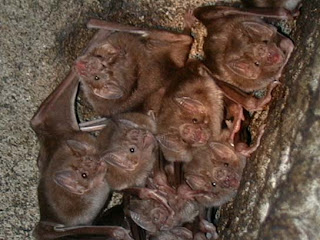

Vampire bats use echolocation, sound and smell in order to find their prey, which can be up to 10,000 times the size of this tiny predator, and it is because of this that vampire bats have evolved to taking some precautions when feeding. Firstly, the never land on their prey but inside land on the ground close by and crawl up to it, where they are able to detect veins close to the skin's surface with precision, thanks to their heat-sensing nose. Using it's set of sharp front teeth, the vampire bat then bites it's host, immediately jumping back in case the animal wakes up. Contrary to popular belief, vampire bats do not suck the blood of their victims, but inside lap it up using their grooved tongue as it flows out of the wound. Chemicals in the vampire bat's saliva both stop the blood from clotting and numb the area of skin around the bite to prevent the host from feeling anything.


Despite being a unique and versatile predator itself, the vampire bat is still prey to other animals, that can hunt the bat in the air when it comes out to hunt at night. Large, sharp-eyed birds of prey such as hawks and eagles are the most common predators of the vampire bat, along with snakes that hunt the bats in their dark caverns while they are sleeping during the day. Humans though are one of their biggest threats, mainly farmers that are known to poison the bats that commonly feed on their livestock. These poisons (known as vampiricides) are specially designed to spread throughout the whole colony through social grooming, killing hundreds of individuals at a time.


Vampire bats feed exclusively on the blood of warm-blooded animals, drinking up to a teaspoon (25ml) of blood per 30 minute feed. Once having feasted on their host however, the bats are then so bloated that they can barely fly with their weight almost having doubled. It is said that in just one year, an average sized vampire bat colony can drink the blood of 25 cows, but their metabolism is so fast that they must feed every two days to ensure their survival (blood is very nutritious containing high amounts of water). The nearly 20 teeth in the bat's mouth are mostly redundant due to their liquid diet, apart from the set of razor-sharp incisors at the front used for biting flesh.


All three subspecies of vampire bat have been listed as being of Least Concern of becoming extinct in the wild in the immediate future, due to the fact that they are widespread and feed on a variety of warm-blooded animals. Deforestation of their natural habitats along with persistent human efforts to eradicate who colonies at a time however, have led to population declines in certain areas. Scientists have also discovered though that the anti-coagulant found in the bat's saliva, proves to more effective at preventing blood clotting than any medicine, meaning that this could have significant positive implications for patients with strokes or heart attacks.

Saturday, March 26, 2011

Turkey


True Wild Life | Turkey | The turkey is a large bird that is closely related to other game birds such as pheasants, chickens and quails. The turkey has become famous across the western world as being a special meal on large family occasions including Christmas and Thanksgiving. Despite their large size, turkeys are surprisingly adept fliers and can be seen flying beneath the forest canopy looking for somewhere to perch. Although turkeys do nest in the trees, they are most commonly found in open forests, woodlands and grasslands.

There are two different species of turkey which are the wild turkey and the ocellated turkey. The wild turkey is found naturally in the open forests of North America and is the heaviest of all of the game bird species. The ocellated turkey is found in south-east Mexico and although the same size as the wild turkey, the ocellated turkey is roughly half the weight of the wild turkey. The wild turkey is a large, round looking bird that has long, thin legs with three toes on each foot to help with balance and for scratching around in the dirt. The male wild turkey has a red, featherless head and throat which has small growths on it known as caruncles.


The ocellated turkey is a more elegant looking bird and, although closely related to the wild turkey, the ocellated turkey is very similar in appearance to a female peacock. The ocellated turkey has a narrow body and long legs, and the males have featherless necks and heads which can be red or blue in colour and are often more subtle than the those of the male wild turkeys. The turkey is an omnivorous animal meaning that it eats both plants and plant matter, and other animals. The turkey primarily eats nuts, seeds, fruits, berries and insects which is often finds whilst scratching around on the forest floor. The turkey also eats small reptiles, amphibians and even rodents should it get the chance.


Despite its large size, both species of turkey have a number of predators within their natural environment. Foxes, snakes, raccoons, wildcats and humans are the most common predators of the turkey. During the mating season, male turkeys make gobbling noises in order to try and attract a female turkey to mate with. The female turkey finds somewhere safe to make her nest and lays between 6 and 12 eggs which hatch after an incubation period of about a month. Today, the turkey is one of the most popular meats to eat on festive occasions and is farmed in large numbers across the western world. It is thought that over 250 million turkeys are farmed in the United States every year!