Showing posts with label Endangered. Show all posts

Friday, August 12, 2011

African Wild Ass


True Wild Life | African Wild Ass | The African Wild Ass is a wild member of the horse family, Equidae. This species is believed to be the ancestor of the domestic donkey which is usually placed within the same species. They live in the deserts and other arid areas of northeastern Africa, in Eritrea, Ethiopia and Somalia; it formerly had a wider range north and west into Sudan, Egypt and Libya. About 570 individuals exist in the wild. The African Wild Ass is suited for life in the desert, capable of going on for up to three days without drinking water.


African wild asses are well suited to life in a desert or semidesert environment. They have tough digestive systems, which can break down desert vegetation and extract moisture from food efficiently. They can also go without water for a fairly long time. Their large ears give them an excellent sense of hearing and help in cooling. Because of the sparse vegetation in their environment wild asses live somewhat separated from each other (except for mothers and young), unlike the tightly grouped herds of wild horses. They have very loud voices, which can be heard for over 3 km, which helps them to keep in contact with other asses over the wide spaces of the desert.

The African Wild asses can run swiftly, almost as fast as a horse. However, unlike most hoofed mammals, their tendency is to not flee right away from a potentially dangerous situation, but to investigate first before deciding what to do. When they need to, they can defend themselves with kicks from both their front and hind legs. The African Wild Ass eats plant material, often eating thorn bushes and tougher plants that other animals ignore. They need to have water at least every three days, but they are able to survive on water that is dirty and brackish and can get a lot of their moisture from the plant material that they eat.


Sexual maturity of the female ass usually happens by the time she reaches two. Males can also reproduce at two, but it is so competitive that they usually are forced to wait until they are around four. Males are very territorial and will often hold a huge territory that is about 23 km, and they mark the edges of their territories with dung. Other males are allowed in, but they are kept away from the females as much as possible. Male donkeys will bray when the females are in season, and a dominant male of a territory has first right to breed with any female that comes around. The gestational period usually lasts 11-12 months, and the females in the wild usually give birth only once every two years. The young are weaned at about six months of age, and the animals can live approximately 40 years.


In addition to their struggle with domesticated livestock to secure food and water, the African Wild Ass also became a hunted animal for consumption and medicine. Many dangerous weapons found their way into the homeland of the African Wild Ass due to the war between Ethiopia and Eritrea. There is a concern that these weapons will be used more often from now on to hunt more of the African Wild Ass. Currently, there is a protection program in progress to move the African Wild Ass into a protected area of Israel.

Thursday, August 11, 2011

Quokka


True Wild Life | Quokka | The Quokka is a small macropod about the size of a domestic cat. Like other marsupials in the macropod family , the Quokka is herbivorous and mainly nocturnal. It can be found on some smaller islands off the coast of Western Australia, in particular on Rottnest Island just off Perth and Bald Island near Albany. Quokkas resemble a small wallaby, with small rounded ears, and brown or greyish fur.


In the wild, its roaming is restricted to a very small range in the South-West of Western Australia, with a number of small scattered populations on the mainland, one large population on Rottnest Island and a smaller population on Bald Island near Albany. The islands are free of foxes and cats. On Rottnest, it is common and occupies a variety of habitats ranging from semi-arid scrub to cultivated gardens.


Quokka weighs 2.5 to 5 kg and is 40 to 90 cm long with a 25 to 30 cm tail  which is rather short for a macropod. It has a stocky build, rounded ears, and a short, broad head. Although looking rather like a very small, dumpy kangaroo, it can climb small trees and shrubs. Its coarse fur is a grizzled brown colour, fading to buff underneath.


Quokka feeds at night on native grasses and the leaves of shrubs. They need drinking water, but can survive long periods without it. This is helped by the remarkable ability of the Quokka to reuse a portion of their bodies waste products. These animals breed year round, and have a gestation period of 4 months before a new joey is born. The joey lives in its mother's pouch for the first 25 weeks of its life. After leaving the pouch, the joey continues to suckle at its mother's teets for a further 10 weeks.


There were once a lot of Quokkas, but they are now in danger of extinction. They are under threat from development that has destroyed the wetlands where they live and are also threatened by other animals that have been introduced by humans. Quokkas are preyed on by cats and foxes, who are non-native animals in Australia. Their wetland habitat is also disturbed by feral pigs. While efforts are being made to protect them, it is thought that the numbers of Quokka still have not recovered.

Wednesday, August 10, 2011

Huon Tree Kangaroo


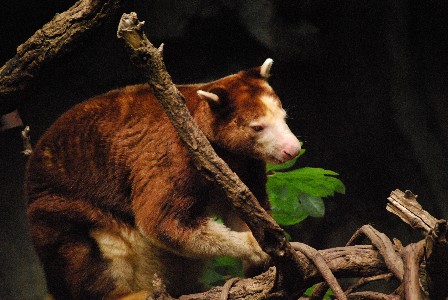
True Wild Life | Huon Tree Kangaroo | Huon Tree Kangaroo (Dendrolagus matschiei), also known as the Matschie's Tree Kangaroo is a tree kangaroo  native to the Huon Peninsula of North Eastern New Guinea. Under the IUCN classification, Huon Tree Kangaroo is endangered. With a body and head length of 20 to 32 inches, Huon Tree Kangaroo are much smaller than Australia's well-known red kangaroo. 


There is no particular season in which they breed. Gestation lasts 32 days and joeys of captive bred individuals leave the pouch after 13 ½ months. The average life span of the Huon Tree Kangaroo in the wild is unknown, but is at least 14 years. The life span of the kangaroo in a zoo is about 20 years. The Huon Tree Kangaroo can only be found on the Huon Peninsula on the northeast coast of Papua New Guinea. They live in forests that are usually foggy.Unlike other species of kangaroos, the Huon Tree Kangaroo spends most of its time living in trees. They even eat and sleep in trees.


The most distinctive trait of all tree kangaroos is the hair whorl they possess. It is a patch of hair that goes out in many directions and its location ranges from up near the shoulders all the way down to the tail. The Huon Tree Kangaroo is golden on its ventral side, lower parts of its limbs, ear edges, belly, and tail, and the rest of its body is a chestnut brown color, except for usually having a dark stripe down its back. Their faces are typically an array of yellow and white colors. The Huon Tree Kangaroos are similar in color and size to Dendrolagus dorianus, the Doria’s tree kangaroo. Huon Tree Kangaroos ears are small and bear-like looking and they do not have a good sense of hearing because of it. They have curved claws on their forelimbs and soft pads on their hind limbs that aid in their climbing ability, and they have some independent movement of their digits as well as good dexterity due to their forelimbs being able to bend a great deal.


The Huon Tree Kangaroo are mainly folivorous, eating anything from leaves, sap, insects, flowers, and nuts.  Since they eat high fiber foods, they only eat maybe about 1 to 2 hours throughout the day and the other time of the day they are resting and digesting their food. Their digestion is similar to that of the ruminants; they have a large, “tubiform forestomach”, where most of the fermentation and breakdown of tough material takes place at; in the hind stomach, there is a mucosa lining with many glands that help absorption begin here.


The Huon Tree Kangaroo lives only on the Huon Peninsula of Papua New Guinea. Usually we think of kangaroos as animals that hop around grasslands. However, Huon Tree Kangaroos are an exception. They live in forests and are more adept at climbing trees than they are at moving on land. Today, as the population on the Huon Peninsula grows, more and more of the kangaroo's precious forests are being converted into farmland. Continued habitat loss is pushing the Huon Tree Kangaroo toward the brink of extinction.

Goodfellow's Tree Kangaroo

 
True Wild Life | Goodfellow's Tree Kangaroo | Goodfellow's Tree-kangaroo also called the Ornate Tree Kangaroo, belongs to the family Macropodidae, which includes kangaroos, wallabies and their relatives. The species is native to the rainforests  of New Guinea, and the border of central Irian Jaya in Indonesia.  Under the IUCN classification, the species is listed as Endangered, which is a result of overhunting and human encroachment on their habitat.


Like other tree-kangaroos, Goodfellow's Tree-kangaroo is quite different in appearance from terrestrial kangaroos. Unlike its land dwelling cousins, its legs are not disproportionately large compared to its forelimbs which are strong and end in hooked claws for grasping tree limbs, and it has a long tail for balance. All of these features help it with a predominantly arboreal existence. Goodfellow's Tree-kangaroo has short, woolly fur, usually chestnut to red-brown in color, a gray-brown face, yellow-colored cheeks and feet; a pale belly, a long, golden brown tail, and two golden stripes on its backside.  It weighs approximately 7 kg. 


Although it feeds mainly on the leaves of the Silkwood tree, other morsels are accepted when available, including various fruits, cereals, flowers and grasses.  It has a large stomach that functions as a fermentation vat, similar to the stomachs of cows and other ruminant  herbivores, where bacteria break down fibrous leaves and grasses.


Unlike other kangaroos, Goodfellow's Tree Kangaroos like to stay in the treetops rather than hopping around on the ground. They choose to live in the treetops to protect themselves from enemies on the ground. The New Guinea Island used to be rich in nature but as it became the major exporter of lumbers and minerals, the forests were destroyed by the human. The more and more safe places to live for Goodfellow's Tree Kangaroos are now disappearing.


To make the matters worse, roads have been extended to the middle of a forest. It has made Goodfellow's Tree Kangaroos an easy prey for hunters who go after their meat. They are usually active in the morning and evening but those who live in the area where there are many people have become nocturnal. Once they chose to live in the treetops to protect themselves from the enemies; maybe now they have changed their lifestyle for fear of human, their new enemies.

Kuroiwa's Ground Gecko


True Wild Life | Kuroiwa's Ground Gecko | Kuroiwa's Ground Gecko, or the Okinawan Ground Gecko, is a species of lizard in the Gekkonidae family. It is endemic  to Japan.  Kuroiwa's Ground Geckos only live on the Okinawa Islands and Tokunoshima of the Amami Islands.


The Kuroiwa's Ground Gecko has features similar to what a lizard has. The number of Kuroiwa Ground Gecko is becoming fewer because the outside animals that human have brought in often attack them, and size of forests is shrinking. Kuroiwa's Ground Geckos eat insects, spiders and worms. Kuroiwa's Ground Geckos can't climb up a tree because they have no specialized toe pads like other geckos do. They mainly roam around on the ground.


The Kuroiwa's Ground Gecko is a very unusual creature that only lives on the Okinawa Islands and Tokunoshima of the Amami Islands. Unlike other geckos, it can close its eyelids and has no specialized toe pads. The Kuroiwa's Ground Gecko has features similar to what a lizard has. Because the pattern of the skin varies depending on which island it lives, the Kuroiwa's Ground Gecko is further separated into four different species.


The number of the Kuroiwa's Ground Gecko has become fewer because of forest clearing. It also faces problems like other creatures living in Okinawa may have. For itself being so exotic, Kuroiwa's Ground Gecko is also popular to keep as a pet. Even it is forbidden to keep the Kuroiwa's Ground Gecko as a pet but the human still continue ignore the rule. There are still many trades of the Kuroiwa's Ground Gecko in the black market.

El Hierro Giant Lizard

 
True Wild Life | El Hierro Giant Lizard | The El Hierro Giant Lizard is a species that can be found on the island of El Hierro, one of the Canary  Islands (Spain). The species was once present throughout much of the island and on the small offshore Roque Chico de Salmor, but is now confined to a small areas of cliff with sparse vegetation. It is currently restricted to the southern end of the Risco de Tibataje, in la Fuga de Gorreta, located between Guinea and the so-called Paso del Pino. 


El Hierro giant lizard is a thickset reptile with a broad head. Adults are dark grey to brown in colour, with two rows of pale orange patches running along its sides. Its belly is mostly brown, but has an orange to red colouration towards the middle. Older El Hierro Giant Lizards are mainly black with some grey. Males are larger than females. El Hierro Giant Lizard is a very large lacertid that can grow beyond 20 cm in length, and lives only on the Hierro Island of Spain's Canary Islands. It used to exist in a broader area but now only exists in a certain part of Hierro Island. Their number is down to a mere 300 to 400, including those returned to wilderness by humans.


The El Hierro giant lizard is omnivorous. It eats plants and insects. Mating begins in May and the 5 to 13 eggs are laid from June until the end of August. Their eggs hatch after 61 days. Many reptiles become active after raising their body temperature by sunbathing. The body of the El Hierro Giant Lizard can be as hot as 40 degrees Celsius after sunbathing.


The number of El Hierro Giant Lizards has dropped because of a scarcity in food plants and an increase in attacks by seagulls and other animals. Although the extent of human-induced changes to the ecosystem is unknown, with so few El Hierro Giant Lizards in existence, any further human-induced changes to their environment could cause them to go extinct in a flash. To avoid this tragic scenario, Spain has enlisted the entire country to help protect the El Hierro Giant Lizard.


Tuesday, July 19, 2011

Anderson's Crocodile Newt

 
True Wild Life | Anderson's Crocodile Newt | The Anderson's Crocodile Newt  is a species of salamander in the Salamandridae family. It is found in Japan and Taiwan. Its natural habitats are subtropical or tropical moist lowland forests, subtropical or tropical seasonally wet or flooded lowland grassland, swamps, and freshwater marshes. It is threatened by habitat loss. The Anderson's Crocodile Newt gets its name from its bumpy ribs.


The Anderson's Crocodile Newt looks the same today as long, long ago. Their nickname is "the living fossil". They've survived through time but the forests and woods are vanishing, and they're in trouble. They love munching on bugs and beetles, and worms for a snack.


It is an amazing creature because all through time, it hasn't changed a bit. Nicknamed "the living fossil", he's the link to all ancient animals. It received its name from his bumpy ribs. His ribs are his charm and his cool dinosaur look.


The Anderson's Crocodile Newt, a super survivor of time, is facing extinction. People are building roads and resorts on top of the Anderson's Crocodile Newt's home; the forest and woods, and now it is homeless. If the Anderson's Crocodile Newt falls into a roadside ditch, it won't be able get out and it will die! Anderson's Crocodile Newt hasn't changed through time because there was never a problem with the forest and woods. It can't survive with all of this sudden change.

Volcano Rabbit


True Wild Life | Volcano Rabbit | The Volcano Rabbit also known as teporingo or zacatuche (Romerolagus diazi) is a small rabbit that resides in the mountains of Mexico. Volcano Rabbits are the second smallest rabbit in the world, only the pygmy rabbit is smaller.


The Volcano Rabbit lives at a high altitude of 3,000 meters above sea level. Grasslands have expanded into the highlands, making it difficult for the rabbit to find food and make their nest holes. Although the Volcano rabbits are not found outside of Mexico there are a handful of isolated populations away from the slopes of the volcanoes but these are very few and far between. The four volcano slopes where these unique rabbits reside are the Tlaloc, El Pelado, Iztaccihuatl and Popocatepetl volcano slopes. 


Volcano Rabbits make their nests deep in the grass. Not only do they eat the grass, but they also use it to hide from their enemies. Volcano Rabbits feed on zacaton grasses, herbs and the bark of alder trees. During the rainy season they will also eat corn and oats.


Volcano Rabbits breed throughout the year with a peak during the warm summer. After a gestation period of 38 - 40 days, they will give birth to 1 - 3 young. At birth the youngsters are covered in fur but their eyes are closed. They are weaned after approximately 20 days and they reach sexual maturity at 4 months old.


Another problem is that the Volcano Rabbits live on an active volcano. If this volcano were to erupt, it would wipe out their small population. So, zoos and preservation centers are working quickly to breed more Volcano Rabbits.

Amami Rabbit

 
True Wild Life | Amami Rabbit | The Amami Rabbit  or Amamino kuro usagi, also known as the Ryukyu Rabbit, is a primitive dark-furred rabbit which is only found in Amami Ìshima and Toku-no-Shima in Japan. The dark-furred Amami Rabbit is known as a living fossil. Its characteristics are identical to rabbits who lived five million years ago. With its small ears and dark eyes the Amami Rabbit (Pentalagus furnessi) contrasts greatly with its more familiar fluffy, white relatives, and yet it's the Amami's distinctive features that make this rabbit so important to the study of the animal world. The Amami Rabbit has remained essentially unchanged since the Miocene Epoch of the Neogene Period, or approximately five million years. It is believed that its ancestors diverged from other leporids, or rabbits and hares, approximately 20 million years ago.

The Amami Rabbit has thick, wooly, dark brown fur that takes on a reddish shade on its underbelly as it ages. It has small ears and small eyes and short legs, but a large, stocky body. It also has a longer face, or snout, than most rabbits. Amami Rabbits do not have tails. They do, however, have long, curved, inch-long nails.


Baby Rabbits are called kits, kittens, or bunnies. Some sources say the Amami Rabbit only has one kit at a time, and other sources say they have two to three, but it is agreed that they generally have two litters each year. The mother builds a den lined with plant materials and tufts of fur then seals the top with the same material so it looks like the rest of the forest floor. Like other rabbits, the mother leaves her offspring to hunt and only returns every other night in an effort to keep predators from locating her den. She can even feed the kit without completely uncovering the den. She unseals the den when the kit is between four and seven weeks old and the baby rabbit joins its mother on the evening hunt for food.


The Amami Rabbit eats grass, fresh branches, and nuts. The Amami Rabbit raises its offspring in rabbit holes. Except at times when the mother feeds milk to her offspring, she will cover the rabbit hole with dirt to conceal it. Isn't that clever!


The reason why the Amami Rabbit retains its primitive form is because this form best suits them for life on the island. But as more people came to the island, the environment started to change. People continued to cut down trees, wiping out sources of food and refuge for the Amami Rabbit. Amami Rabbits are also frequently attacked by mongooses, which were originally brought to the island to exterminate the Habu, a venoemous snake. Today, the Amami Rabbit is on the brink of extinction.

Saturday, July 9, 2011

Brazilian Tapir


True Wild Life | Brazilian Tapir | The South American Tapir (Tapirus terrestris), or Brazilian Tapir (from the Tupi tapi'ira) or Lowland Tapir or (in Portuguese) Anta, is one of four species in the tapir family, along with the Mountain Tapir, the Malayan Tapir, and Baird's Tapir. It is the second largest land mammal in South America, after Baird's Tapir. The Brazilian Tapir (also known as the South American Tapir) is known to be a fantastic swimmer and the Brazilian Tapir is generally found close to water in the Amazon Rainforest.


It is dark brown in color, paler in the face, and has a low, erect crest running from the crown down the back of the neck. The round, dark ears have distinctive white edges. The South American Tapir can be found near water in the Amazon Rainforest and River Basin in South America, east of the Andes. Its range stretches from Venezuela, Colombia, and Guianas in the north to Brazil, Argentina, and Paraguay, in the south, to Bolivia, Peru, and Ecuador in the West.


It is an herbivore. Using its mobile snout, this tapir feeds on leaves, buds, shoots, and small branches that it tears from trees, fruit, grasses, and aquatic plants.


The social life of the South American tapir is unknown. In the San Diego zoo, the captive group forms a structured herd, with dominant and subordinate animals of both sexes. The dominant male and female make what is called the 'sliding squeal', less than a second in duration. On hearing this sound the others make a 'fluctuating squeal', which is longer and quavers rather than merely decreasing in pitch. This is also uttered when a dominant individual approaches, apparently as an appeasement call and as a sign of pain or fear. Tapirs also utter a challenging snort, and a click made with the tongue and palate, perhaps as a species identification.

Mountain Tapir


True Wild Life | Mountain Tapir | The Mountain Tapir or Woolly Tapir  is the smallest of the four species of tapir and is the only one to live outside of tropical rainforests in the wild. It is most easily distinguished from other tapirs by its thick woolly coat and white lips. Their wooly coat is dark brown in colour and they have pale coloured cheeks and throat. Their ears are large and are coloured white on the rims, they have small eyes and a large proboscis.


The Mountain Tapir lives, as the name implies, high in the mountains. But their numbers have diminished because farmers have extended the grasslands for domesticated livestock into the mountains. Mountain Tapirs are found in the forests and grasslands of the Andes at altitudes over 2,000 m (6,560 ft). They are active at night and spend their days resting among thick vegetation.


Tapirs are herbivores, and eat a wide range of plants, including leaves, grasses, and bromeliads. In the wild, particularly common foods include lupins, Gynoxys, ferns, and umbrella plants. It also seeks out natural salt licks to satisfy its need for essential minerals.


The Mountain Tapir is nocturnal, moving during daybreak and nightfall. In the afternoon, they hide in the bushes.


The Mountain Tapir has always been prey to food and game hunting. And now, there are plans to begin mining their mountains for minerals, further destroying the homes of Mountain Tapirs. Because Mountain Tapirs continue to vanish even today, increased measures must be taken to expand the protected area. Otherwise, they will become extinct in the very near future.